
Search is changing faster than ever. More and more people no longer rely only on classic Google results — they ask AI engines like ChatGPT and Google AI Overview and receive a ready-made answer.
This changes the rules of digital marketing.
For many years I worked in traditional SEO. But over the last year, I saw a clear shift in user behavior. I didn’t rely on theory or trends — I tested, analyzed, measured, and learned from real projects.
In this article I share the system I built from experience: How to make your website appear inside AI-generated answers, not only in search result links.
No theory. Only what works in practice.
✔ Analyzed websites that consistently appear in AI answers
✔ Studied how their content is structured
✔ Tested different page layouts Checked what type of wording gets cited
✔ Implemented methods on real client projects
✔ Measured results over time
From these tests I built a repeatable system.
What worked stayed. What didn’t work was removed.
Traditional SEO goal: Rank high in Google’s list of links.
AI Search goal: Become the source the AI selects to build its answer.
Simple difference:
SEO → User clicks your link to find the answer. AI Search → The answer appears instantly — and your site is cited as the source.
This creates powerful advantages: Visitors coming from AI answers are high-intent, high-quality users.
From my testing, AI models look for:
• Clear content structure • Direct answers to real questions • Strong topical authority • Natural human-like language • Credibility and consistency • Logical internal linking
AI doesn’t think in “keywords”. It looks for who truly understands the topic.
In old SEO, one strong page could rank. In AI Search — one page is not enough.
What works:
• Choose a main topic • Create multiple supporting pages • Each page answers a different aspect • Connect them with internal links
This tells AI: “This website deeply covers this subject.” And that earns trust.
Websites appearing in AI answers share common structure:
• Clear H2 / H3 headings • Short paragraphs • Direct statements • Bullet lists • Question-and-answer sections
Goal: Make content easy to digest for humans and AI.
AI engines are designed to answer questions.
So content that performs best includes:
• “How to…” • “What is…” • “Why…” • “How long…”
Every project I build today includes a real FAQ section. This is one of the most cited content types by AI.
AI optimization sits on top of classic SEO.
You still need:
• Fast site speed • Clean technical structure • Schema / JSON-LD • Proper internal linking • Error-free indexing
Without solid SEO foundations — AI will not trust your site.
Schema helps AI understand:
• Who you are • What your site is about • How pages relate • Where Q&A content exists
In several projects I tested, adding proper schema became a turning point in AI visibility.
❌ Publishing raw AI-generated content without expert editing
❌ Trying to promote only one page
❌ Ignoring technical SEO
❌ Expecting instant results
AI builds trust over time. This is a long-term advantage for those who start early.
• Visibility before competitors • Strong authority branding • Higher-quality traffic • Users ready to take action
In short: Not just more traffic — better traffic.
✅ Build a topic content cluster
✅ Create supporting pages
✅ Write direct answers to real questions
✅ Add FAQ sections
✅ Connect pages with internal links
✅ Implement Schema / JSON-LD
✅ Maintain strong technical SEO
✅ Review performance monthly
After years in SEO and real AI testing:
Those who build AI-ready websites today will lead tomorrow’s search landscape.
This is not a trend. It’s the new standard of search.
And those who act early gain a real competitive advantage.
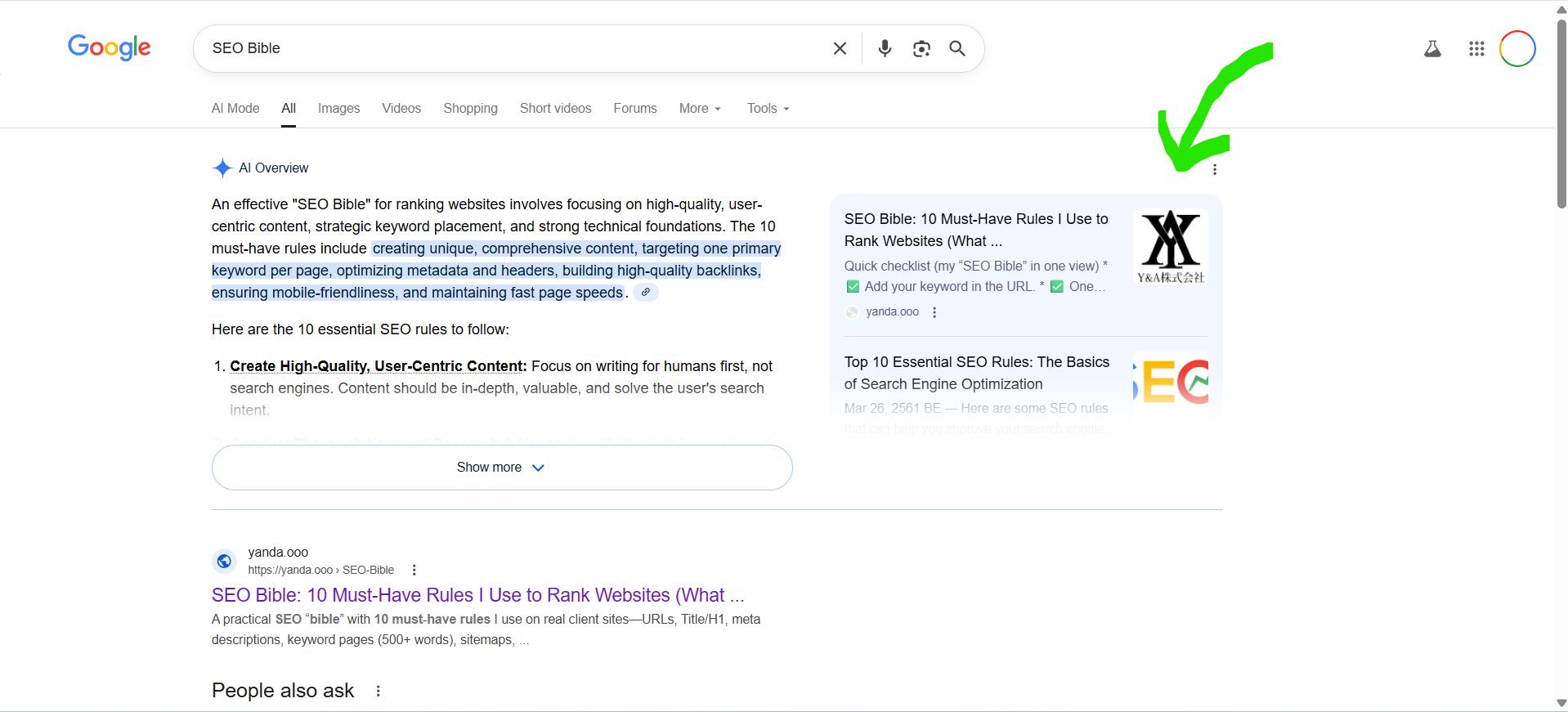
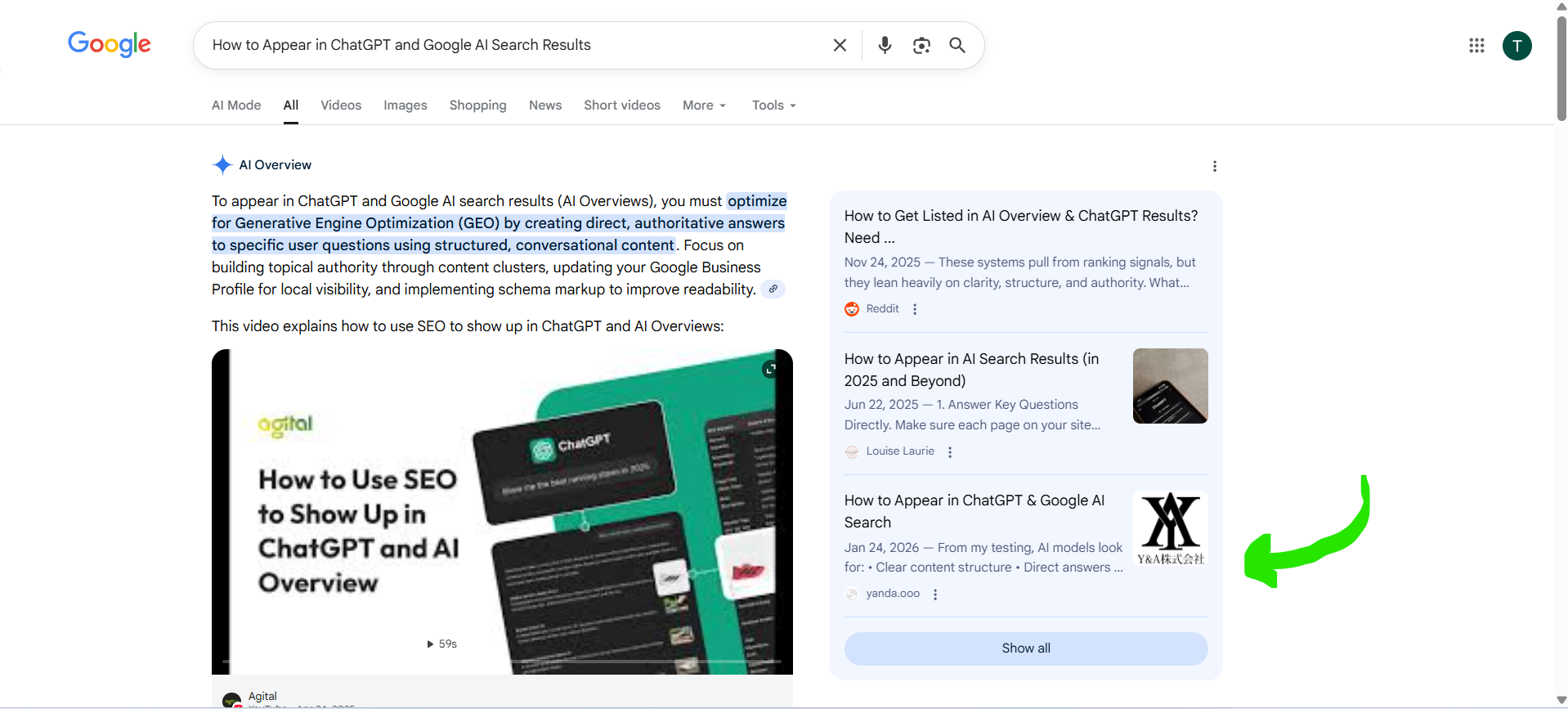
{
"@context": "https://schema.org",
"@type": "FAQPage",
"mainEntity": [
{
"@type": "Question",
"name": "How can my website appear in ChatGPT answers?",
"acceptedAnswer": {
"@type": "Answer",
"text": "By building strong topical authority, writing clear question-based content, adding FAQ sections, and implementing correct Schema markup so AI can understand and trust your content."
}
},
{
"@type": "Question",
"name": "Does AI optimization replace traditional SEO?",
"acceptedAnswer": {
"@type": "Answer",
"text": "No. AI optimization builds on top of classic SEO. Technical SEO, site speed, and clean structure remain essential foundations."
}
},
{
"@type": "Question",
"name": "How long does it take to see results in AI search?",
"acceptedAnswer": {
"@type": "Answer",
"text": "AI visibility grows as authority builds. Improvements usually appear gradually over several months."
}
},
{
"@type": "Question",
"name": "What is GEO (Generative Engine Optimization)?",
"acceptedAnswer": {
"@type": "Answer",
"text": "GEO is the process of optimizing websites to be selected and cited inside AI-generated answers rather than only ranking in classic search results."
}
}
]
}
Sample text. Click to select the Text Element.
In my recent testing, one trend is impossible to ignore: users are clicking less on traditional search results.
AI search engines now deliver instant, summarised, personalised answers. This means users often get what they need without clicking any website at all.
Multiple industry studies already show a significant drop in classic Google clicks due to AI-generated overviews. From my perspective, this confirms one thing:
Visibility inside AI answers is becoming as important as ranking itself.
For brands, this is not a threat — it is an opportunity. Those who adapt early will own attention in the next phase of search.
Traditional SEO relied heavily on keyword targeting. AI search works differently.
From everything I tested, AI engines prioritise:
• Credibility • Contextual relevance • Clear expertise • Trustworthy sources
AI models summarise information from multiple websites to generate answers. To be selected, your content must look like a reliable source, not just a well-optimised page.
That is why modern optimisation is shifting from keyword focus to authority and trust building.
SEO gets your pages ranked. GEO gets your brand mentioned inside AI-generated answers.
From my implementation work, GEO focuses on:
• Structuring content so AI can extract answers easily • Writing conversational, question-based content • Building strong topical authority • Reinforcing credibility with sources and references
If SEO brings traffic, GEO brings presence inside the answer itself.
Both now work together.
It is also important to understand how modern AI search actually works.
Large Language Models (LLMs) such as ChatGPT or Claude rely on trained knowledge. But AI search engines like Google AI Overviews, Perplexity and Gemini combine:
• Live web search results • LLM reasoning • Real-time summarisation
This means your website still needs:
• Traditional SEO visibility • Crawlable, structured content • Clear topical signals
So GEO does not replace SEO — it builds on top of it.
AI search answers questions the way people naturally ask them.
From my tests, content performing best in AI answers targets queries like:
• “How do I…” • “What is the best way to…” • “Why does…” • “How long does…”
This is why I always build:
• Step-by-step guides • Problem-solving content • FAQ sections
AI engines prioritise specific, actionable, question-based content.
One finding that repeated in my testing:
Websites that publish consistently gain AI visibility faster.
Regular publishing signals:
• Ongoing expertise • Active website • Updated information • Reliable source status
Just like classic SEO, AI search rewards sites that continuously deliver value.
Another pattern I observed:
Content that includes:
• Industry statistics • Expert quotes • Referenced sources
is far more likely to be cited by AI.
This reinforces trust signals and helps AI validate your content as authoritative.
Google is already moving beyond AI Overviews. Its new AI Mode transforms search into a full conversational experience.
Key characteristics:
• Dialogue-based search • Follow-up question memory • Multi-format answers (text, links, images, video) • Deep research summarisation
When this becomes mainstream, brands that are not optimised for AI visibility will simply not appear.
This is why acting now gives a lasting advantage.
From my experience in real projects:
• Classic search clicks are declining • AI summaries are gaining dominance • Trust and authority matter more than ever • Early adopters gain disproportionate exposure
The conclusion is clear:
If your brand is not present inside AI answers, you are invisible in the next generation of search.